
The objectives of Sales and Operations Planning (S&OP) is to develop an execution plan that matches the strategic goals of the company and the current business plan. The Sales, Operations, and Finance team works to align innovation, supply chain, marketing, and sales towards those goals. It is a customer-driven business process with a mid to long-term horizon.
The S&OP plan is a tactical plan with 6 plans linked to it:
- Financial plan
- Sales plan
- Operations Plan
- Inventory Plan
- Marketing Plan
- Product Life Cycle Plan
The S&OP team uses these inputs to manage product mix, underperforming products, the bottom rungs of the product ladders, and excess inventory. A product ladder is a range of products varying in price and features.
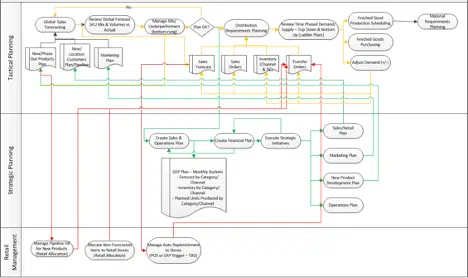
The S&OP plan sets the overall level of manufacturing output (production plan) and other activities. It seeks to satisfy the current planned levels of sales based on inputs from the sales and marketing plan. The plan needs to meet the objectives of profitability, productivity, and acceptable customer lead times. It establishes production rates to affect inventory levels, customer backlog levels, and workforce stability. It needs to look far enough out to plan Labor, Equipment, Facilities, Materials, and Finances. Below is a diagram that illustrates the continuous S&OP process.
The S&OP Team should be sponsored by the President or Chief Executive Officer. The team should include the functional heads of Sales, Marketing, Manufacturing, Product Development, Finance, Supply Chain, and Systems. Key resources for master production scheduling, forecasting, production & inventory control, and procurement should also be included.
The team charter should define the scope. Determine whether it has Global S&OP vs Regional S&OP responsibilities.
The team should meet to define product families. The scope of the S&OP team should not exceed 12 product families. Products included in a specific family most have a proportional impact on:
- Costs
- Revenues
- Production Capacities
- Supplier Capacities
Units of measure must be consistent within a planning family with a direct relationship to the manufacturing process. The units of measure must provide a consistent translation back to the currency for financial analysis.
Next, define a planning format. Below is a time-phased matrix that can serve as a guide:

To bring any level of sophistication to the process we suggest utilizing a formal and integrated S&OP tool such as Outperform S&OP.
To prove out and pilot the S&OP processes you can proceed with the spreadsheet templates available in the link. To get started:
- Extract Sales History
- Capture Production History
- Capture Historic Inventory Levels / Backlog
- Capture Current Forecast
- Capture Current Master Production Schedule / Production Plan.
If you don’t have this information then you should first focus on establishing a formal Enterprise Resource Planning System such as Ramco’s Food and Beverage ERP Solution.
Next use the data extracted and the S&OP spreadsheet or Outperform S&OP to guide a conversation to establish the S&OP Policies:
- Objectives
- Meeting Schedules
- Attendees and responsibilities
- Description of the mechanics of the planning process and horizons
- Definition of demonstrated capacities by product family
- Definition of Rough Cut Capacity Planning Techniques
- Primary product families to focus upon
- Guideline for managing change to the plans
- Description of mechanics to translate to financial plans and budgets
The S&OP team should meet monthly to execute the S&OP process.
Adroit can help you to implement an S&OP process with an implementation plan that includes:
- Formalize Team and Scope
- Define Product Families
- Define Format
- Prepare Pilot Data
- Education / Process Definition
- Define S&OP Agenda
- Facilitate Initial and Subsequent S&OP meetings.